Direct answer
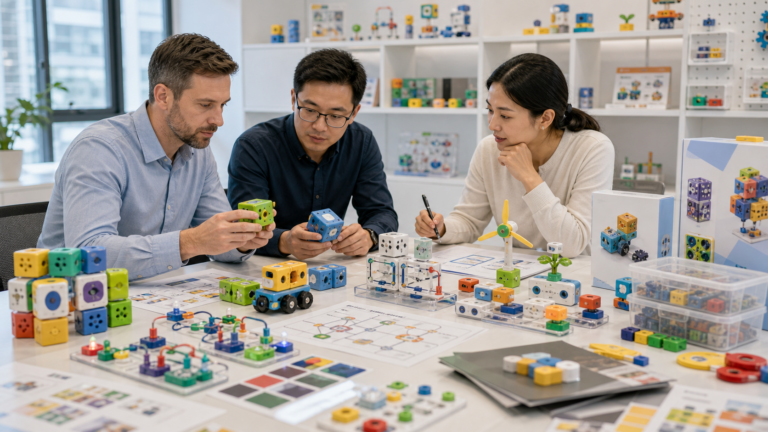
Choose engineering kits for teens by the design process they enable—not by part count. A strong B2B kit maps to explicit learning outcomes, lets students define constraints, prototype, test, compare trade-offs and document evidence, while giving schools clear age guidance, teacher support, replacement parts and market-specific safety files. “For teens” is not a regulatory exemption; intended use and marketing still determine applicable requirements.
Start with the engineering process
A kit becomes educationally useful when students must make decisions, not merely follow assembly steps. The NGSS middle-school engineering design expectations emphasize defining criteria and constraints, evaluating competing solutions, analyzing test data and modifying designs. At high-school level, students are expected to break down complex problems and evaluate trade-offs involving factors such as cost, safety, reliability and environmental impact under the HS-ETS1 framework.
These standards are useful procurement benchmarks even where NGSS is not the local curriculum. Ask whether a kit supports a complete cycle:
- Define a problem and measurable success criteria.
- Identify constraints.
- Build more than one possible solution.
- Test with observable or measurable results.
- Compare trade-offs.
- Improve the design.
- Record evidence and explain the final decision.
A practical procurement inference from the National Academies’ integrated STEM education framework is that buyers should examine learning goals, implementation conditions and assessable outcomes together—not treat “STEM” as a sufficient product description.
YSGO’s STEM Logic Thinking Training Blocks provide a relevant category starting point, while the broader STEM toys manufacturer overview explains the B2B development context.
Procurement comparison table
| Procurement factor | Evidence to request | Warning sign |
|---|---|---|
| Learning outcomes | Skills map, challenge objectives and assessment evidence | “Builds creativity” without measurable tasks |
| Design freedom | Multiple valid solutions and adjustable constraints | Only one prescribed model |
| Testing and iteration | Test procedure, data sheet and redesign stage | Project ends when assembly is complete |
| Age suitability | Intended age, prerequisite skills and supervision guidance | “Teen” used without a documented age rationale |
| Teacher support | Lesson flow, answer guidance, setup notes and timing | Student booklet only |
| Classroom capacity | Group size, kit-sharing plan and reset procedure | No plan for sorting or reuse |
| Replacement support | Part codes, replacement list and reorder process | Entire kit must be replaced for one missing part |
| Version control | Model number, BOM revision and document revision | Parts or instructions change without notice |
| Market readiness | Applicable-requirements matrix and sample-linked reports | Generic certification logo with no scope |
| OEM feasibility | Approved customization list and change-control process | Every change promised before engineering review |
Use the same scorecard across all shortlisted samples. A category-level product catalog can help identify candidates, but final approval should depend on the tested sample and its exact documentation.
Run a sample acceptance test
Do not approve a kit after one successful demonstration. Give the sample to a teacher and a small student group, then record pass/fail findings against a written protocol.
Check that:
- the received inventory matches the sample BOM;
- parts are identifiable without excessive teacher intervention;
- instructions support setup, testing, troubleshooting and reset;
- students can produce different solutions rather than copy one result;
- the activity generates evidence that a teacher can assess;
- repeated assembly does not create immediate functional problems;
- warnings, labels and documents match the tested sample;
- storage and end-of-class sorting are realistic.
Record every defect by part code, document page and sample version. Photography can support the report, but it should not replace a count sheet or functional test record.
Plan for classroom operations
Classroom suitability is partly an operations question. Buyers should define students per kit, lesson duration, setup time, cleanup time, storage method and responsibility for inventory control. Teacher materials should identify preparation steps, likely failure points, extension tasks and what evidence demonstrates learning.
For distributors and education brands, these details also affect sellability. A kit that works in a controlled showroom may still create support costs if schools cannot reset it between classes or identify missing components.
Require replacement parts and version control
Request a coded replacement-parts list before the order is finalized. It should distinguish reusable structural parts, project-specific components and items likely to be lost or damaged. Confirm how replacements are packed and identified, without assuming a particular price, MOQ or lead time.
The supplier should also link the sample, BOM, instructions, packaging and safety documentation to one controlled version. If a component changes, the buyer needs to know whether fit, function, lesson content, warnings or previous test evidence are affected. Uncontrolled substitution can invalidate both classroom instructions and compliance records.
Set clear OEM/ODM boundaries
Possible customization areas may include visual theme, challenge content, instruction language, packaging, branding and selected product configuration. However, feasibility must be confirmed against the exact project.
Treat changes to load-bearing parts, electrical functions, age grading, warnings, component specifications or intended use as engineering and compliance changes—not simple artwork edits. They may require new risk assessment, sample validation or testing. A responsible OEM process separates:
- changes approved through artwork review;
- changes requiring a new functional sample;
- changes requiring document updates;
- changes that may require additional testing.
No supplier should promise performance, compliance scope, MOQ or delivery timing before the customized specification is reviewed.
Apply compliance conditions by market and intended use
“For teens” does not remove toy-safety obligations. In the United States, the CPSC toy-safety FAQ explains that ASTM F963 applies to toys intended for children under 14, while third-party testing requirements apply to toys designed or intended primarily for children 12 or younger. Product design, packaging, advertising and expected users therefore matter alongside an age label.
For a kit with an electrical play function, IEC 62115 covers electrical safety for toys intended for use in play by children under 14. Its scope includes constructional and experimental sets, but it addresses electrical-function safety rather than every possible product requirement.
For the EU, buyers should also monitor the new Toy Safety Regulation transition. The European Commission states that the new rules will apply from 1 August 2030 and will require a digital product passport for toys placed on the EU market.
Applicable requirements and testing depend on the final product, intended age, intended use and target market. Request documents tied to the exact sample and revision; do not rely on an unrelated report or a generic claim that every kit is “fully certified.”
Primary CTA — Compare a STEM Kit Shortlist: Share your intended age, learning goals, class size and destination market so candidate samples can be evaluated against one procurement scorecard.
Frequently Asked Questions
Is a kit with more parts automatically better?
No. Extra parts add value only when they expand meaningful design choices, testing or reuse. They can otherwise increase sorting time, losses and classroom complexity.
Should middle-school and high-school kits use the same challenges?
Not necessarily. Middle-school activities may emphasize defining constraints, comparing solutions and iterative testing. High-school work should generally support more complex systems, prioritized trade-offs and stronger evidence requirements.
Does a “13+” label avoid US toy requirements?
No. CPSC states that ASTM F963 applies to toys intended for children under 14. Intended use and marketing must be reviewed; the label alone does not determine the full compliance position.
What should schools verify in a sample?
Verify inventory, instructional clarity, design freedom, repeatability, student evidence, teacher workload, reset time, replacement-part identification and consistency between the sample and its documents.
Can an OEM logo or packaging change use existing test reports?
Sometimes, but not automatically. Artwork-only changes may have limited impact, while changes to specifications, warnings, intended use, electrical functions or components can require renewed assessment or testing.
Sources and review
- National Academies: STEM Integration in K–12 Education
- NGSS: MS-ETS1 Engineering Design
- NGSS: HS-ETS1 Engineering Design
- U.S. CPSC: Toy Safety FAQ
- IEC 62115:2017 — Electric Toys: Safety
- European Commission: Stronger Toy Safety Rules
Reviewed 16 July 2026 for B2B procurement use. Internal reviewer: YSGO Editorial Team. Requirements can change and must be confirmed for the final product, intended age, intended use, destination market and current production version.