Direct answer
Select a children's robot building kit by verifying four things on the exact sample: what learners assemble, how they control it, what activity support turns the build into a repeatable learning task, and how the finished configuration performs under realistic use. Brand owners, importers and schools should avoid treating movement, sensors, remote control or the word “programming” as proof of open coding or classroom readiness.
Name the buyer and the decision
This checklist is for educational toy brands, distributors, schools and STEM program providers deciding which robot-building direction fits a defined buyer channel and learning task. The decision is: Does the sample combine an understandable assembly process, a truthfully described control method, usable learning support and an acceptable operational and compliance file?
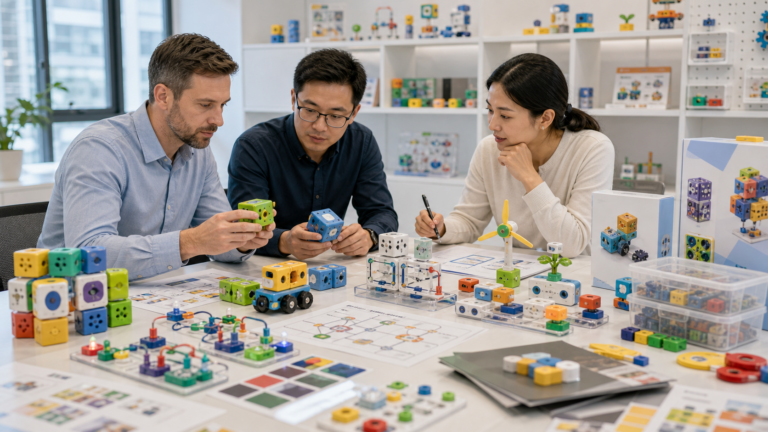
YSGO's STEM Logic Thinking Training Blocks include assembly, module combination and project-based play directions. Buyers should confirm whether a particular model builds a vehicle or responsive structure rather than calling every block set a robot.
Compare the control methods
| Control direction | Learner action | Evidence to request | Claim boundary |
|---|---|---|---|
| Manual or remote control | Sends immediate movement commands | Controller identity, pairing, controls, range conditions and fail behavior | Remote control is not programming |
| Card or tile sequence | Arranges physical commands or logic conditions | Full command set, execution method, error feedback and challenge cards | Describe sequencing; do not imply editable source code |
| Sensor-response build | Connects or selects inputs and observes outputs | Sensor identity, trigger conditions, limitations and repeatable test | Avoid “AI” unless a verified capability supports it |
| Open-code platform | Creates and runs blocks or text code | Exact hardware, software, version, upload path and sample program | Freeze the platform and support lifecycle |
The strongest option depends on the intended activity. A distributor may prioritize a clear demonstration and package story, while a course provider may need troubleshooting, data recording and several challenge levels.
Use YS2965E as an evidence-controlled reference
The YSGO 2026 product catalog for YS2965E records 25 pieces, 60 instruction cards and a package age mark of 8+. It shows build directions including forward and backward movement, turning, reversing alarm, sound response, light response and obstacle avoidance.
These facts make it a relevant sample direction for card-and-module logic and responsive vehicle-building activities. They do not prove open-code programming, a named software platform, autonomous AI, a fixed sensor specification, material, battery configuration or certification coverage. Those points remain model- and project-specific.
Before comparing it with another robot kit, ask both suppliers to demonstrate the same learner task from inventory check through reset. Do not give one sample credit for features shown only in marketing images.
Run a production-intent sample test
- Confirm model, package, BOM, instructions, cards and sample revision.
- Count and identify every structural, electronic and control component.
- Ask the intended facilitator to assemble the first activity from the supplied materials.
- Record learner decisions versus steps copied directly from the instructions.
- Test every claimed movement and response under documented conditions.
- Introduce a wrong connection or command and observe the troubleshooting path.
- Record startup, pairing, battery or power preparation, shutdown and reset.
For classroom use, add group size, facilitator interventions, storage, cleaning, spare parts and next-session readiness. For wholesale, add shelf demonstration, packaging clarity, replacement support and downstream training materials.
Control the main risks
Robot-label inflation: A vehicle shape or moving build does not establish robotics, coding or AI capabilities.
Control ambiguity: “Programmable” must identify what the learner programs and how. Preserve narrower card-and-module language when that is the verified method.
Incomplete support: A working sample can still fail in class if troubleshooting, reset and replacement information are missing.
Applicable requirements and testing depend on the final product, intended age, intended use and target market. Electrical toys may require IEC 62115 review where applicable, alongside mechanical, chemical, battery, labeling and market-specific requirements. YSGO can discuss instructions, activity content, branding, packaging and selected configurations subject to feasibility; do not infer material, power, MOQ, timing or certification.
Get a Model Recommendation: Share the intended age, target market, control method, learning task, class or sales channel, quantity and customization priorities through the YSGO inquiry page so the team can recommend a sample and a model-specific approval checklist.
Frequently Asked Questions
Is every moving building kit a robot kit?
No. Define the assembled system, control method, inputs, outputs and learner decisions. Use a narrower vehicle or responsive-build description when that is what the evidence supports.
Is YS2965E an open-code robot?
Current evidence supports card-and-module logic and specified build behaviors. It does not support an open-code platform claim.
What should a school test besides successful movement?
Test setup, instructions, troubleshooting, group use, floor and environmental conditions, reset, missing-part control, storage, facilitator workload and the consistency of all claims and documents.
Can an OEM package change keep the same compliance file?
Sometimes artwork-only changes have limited impact, but age positioning, warnings, instructions, components, functions or intended use may change the assessment. Confirm the exact variation with the responsible reviewer.
Sources and review
- YSGO 2026 product catalog: specifications for the models discussed above.
- YSGO STEM Logic Thinking Training Blocks
- National Academies: STEM Integration in K–12 Education
- NGSS: Middle School Engineering Design
- U.S. CPSC: Toy Safety FAQ
- IEC 62115:2017+AMD1:2025 — Electric Toys Safety
Reviewed 17 July 2026 for B2B product selection. All functions, age positioning and compliance evidence must match the exact approved sample and order specification.