Direct answer
B2B buyers should classify educational toys by the learning interaction they deliver—not by broad marketing labels. Construction, model-specific card learning, point-and-learn content, memory challenges and button-based early learning serve different channel and content goals. Choose a category by the intended user action, buyer channel, customization workload, sample evidence and operating needs, then confirm exact-model age and compliance scope.
The buyer decision: choose the interaction system
Educational toy brand owners are deciding which category creates a differentiated product line. Importers and distributors are deciding which format can be explained, packaged and replenished reliably. Schools and educational institutions are deciding which activity teachers can organize repeatedly. STEM education brands and course providers are deciding whether a product can support a structured lesson or kit.
The five YSGO lines provide a practical category system. They should not be treated as proof that every product creates the same learning outcome or supports every customization. The YSGO STEM toy manufacturer overview is a commercial starting point for hands-on STEM sourcing; the full product-lines overview supports cross-category comparison.
Educational toy category comparison
| YSGO category | Core interaction | Strong buyer goal | Main approval questions |
|---|---|---|---|
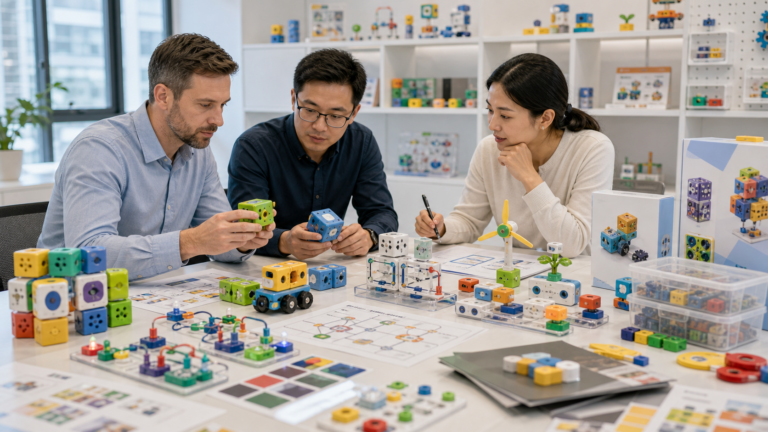
| STEM Logic Thinking Training Blocks | Mechanical assembly, module combination, simple circuit-style exploration and building | Hands-on retail, classroom or course activity | What does the user build, test and change? How are parts stored and replaced? |
| Y-Card Learning Players | Use the model's supported learning cards or content format to hear prompts, answers or audio feedback | Topic-based quiz content and portable learning | Which card or content format, topics, languages and package contents are approved for this model? |
| Y-Pen Smart Learning Pens | Point at a compatible book, card or sheet to trigger the model's supported feedback | Printed-content systems and language localization | Are print coding, audio, page map and pen version synchronized? |
| Y-Challenge Chess & Memory Games | Follow memory, reaction, logic or challenge rules with light and sound feedback | Compact replayable challenge format | Which modes are verified, and how clear are rules, reset and group use? |
| Y-Phone & Y-Pad Early Learning Toys | Press buttons on a familiar phone- or pad-style surface for sound learning and role play | Quickly demonstrated preschool or early-learning format | Does the fixed interaction map fit the intended content, age and channel? |
The useful distinction is the content architecture: components, model-specific card or content formats, synchronized print and audio, verified game modes or a fixed button map.
Verified examples show why category-level claims are insufficient
YS2606A has 60 physical cards, nine listed themes and 120 catalog-listed learning pages. YS2605C is a sound book plus smart pen with point-and-learn, LED and speaker functions, but no confirmed learning-point count. YS2612C has eight verified number, color and memory modes; it must not be described as chess or as having AI play modes. YS2602D has verified A–Z and word learning, question and color/piano modes, while material, power and language variants remain unconfirmed.
This evidence demonstrates different interactions; it does not authorize transferring specifications across the category.
Category selection checklist
- Name the buyer, channel, intended age and primary user action.
- Choose the content system: modules, model-specific learning cards or content formats, printed point map, game modes or fixed buttons.
- Confirm what must be localized and who approves language and educational content.
- Test the exact sample for feedback accuracy, instructions, reset and repeat handling.
- Define package contents, storage, replacement and reorder version control.
- Freeze the sample, BOM, artwork and evidence; use observable activity claims.
Risks, OEM/ODM scope and compliance
Category mistakes include selecting on appearance alone, underestimating content QA, assuming all electronics offer the same interaction, and using one model’s age or feature statement for another. Buyers should also account for replacement books, model-specific cards or content items, components or content revisions where relevant.
YSGO can discuss logo, color, language, learning content, cards, instructions, packaging and selected functions according to model feasibility. Exact materials, battery or power, complete BOM, MOQ, development cost, timing and test evidence remain project-specific. Custom content also needs controlled source text, rights-cleared assets, versioning and functional review.
Applicable requirements and testing depend on the final product, intended age, intended use and target market. Electrical, sound, battery, small-part or other features can change the applicable assessment, so category membership is never a substitute for exact-product evidence.
Choose an Educational Toy Category: Share your target market, buyer channel, intended age, learning interaction, language needs, quantity range and packaging direction so YSGO can recommend a category and list the model facts still requiring confirmation.
Frequently Asked Questions
Is every interactive toy a STEM toy?
No. Sound or light alone does not establish a STEM task. Buyers should identify whether users build, test, compare, follow rules, practice content or simply trigger a response.
Which category is best for multilingual content?
It depends on content volume and workflow. Y-Card, Y-Pen and Y-Phone/Y-Pad formats can involve language content, but capacity, mapping and available customization must be confirmed for the exact model.
Can one test report cover an entire category?
No. Reports and declarations must match the relevant product, configuration and market scope. A category name does not establish coverage.
What should a distributor compare first?
Compare demonstration clarity, package completeness, verified functions, age position, documentation, content or replacement needs, and the process for controlling reorders.
Sources and review
- YSGO product-line information and 2026 product catalog for cited examples
- YSGO Product Lines
- U.S. Consumer Product Safety Commission: Toy Safety FAQ
- American Academy of Pediatrics: Play guidance
Reviewed 17 July 2026 for B2B category-selection use. Category descriptions guide comparison; final model, age, customization, commercial and compliance facts require project-specific confirmation.