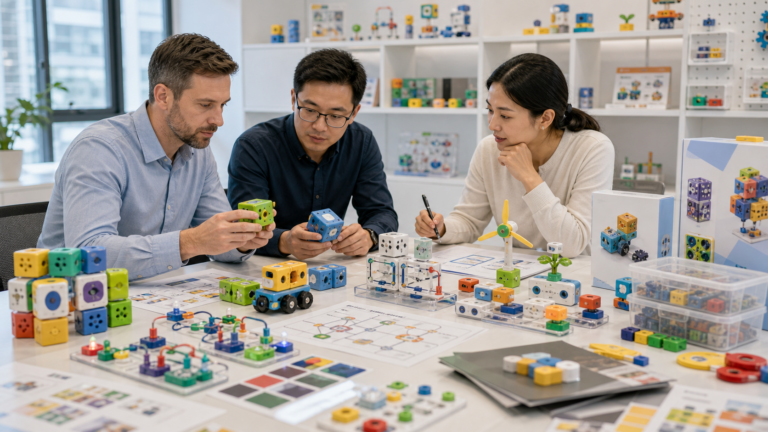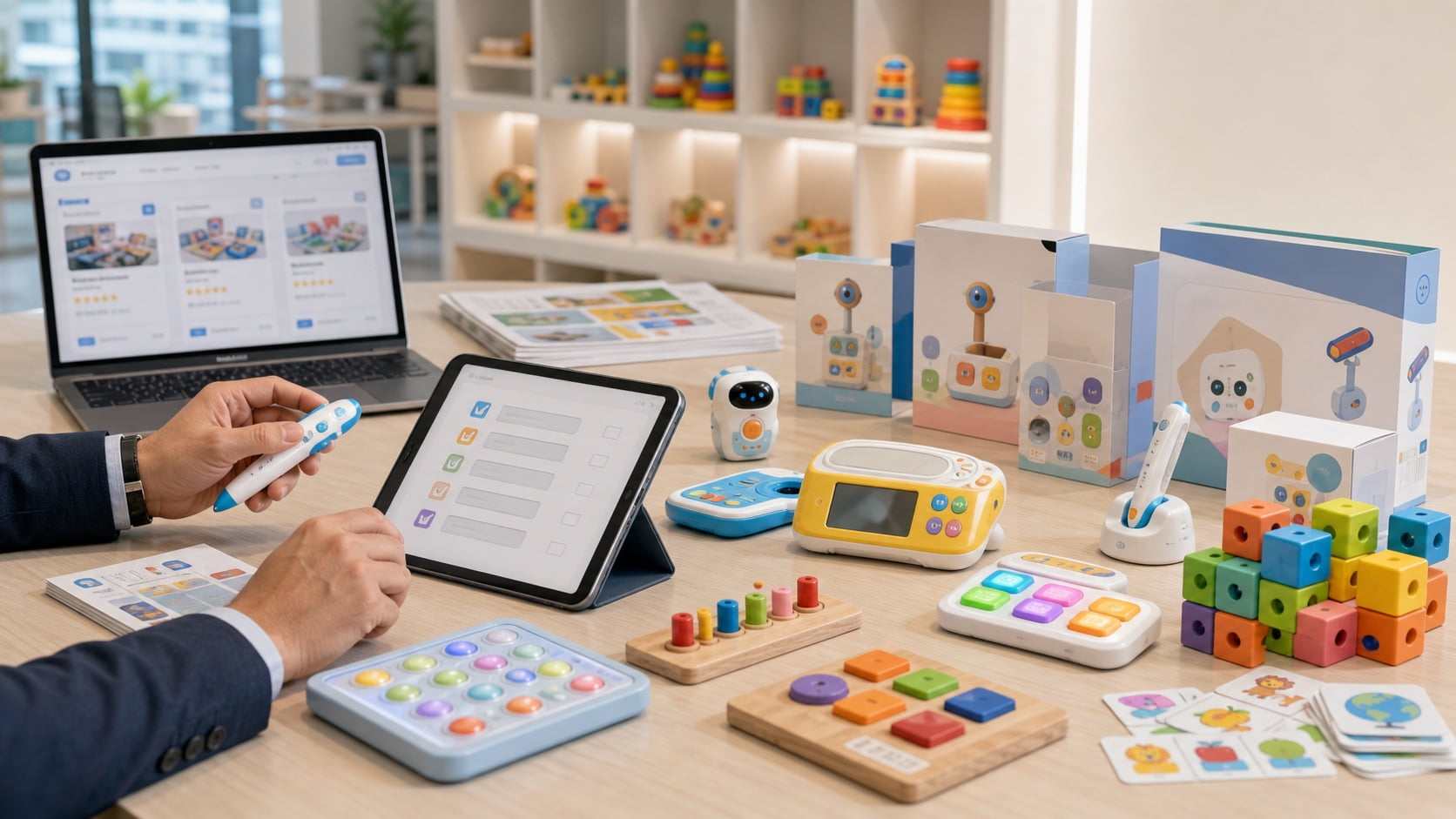
*A structured sourcing process helps buyers compare product fit, customization options, quality support, packaging, and inquiry requirements before choosing a supplier.*
For many importers, distributors, and educational toy brands, China is a practical sourcing base for interactive educational toys because buyers can compare factory-direct product platforms, electronic toy supply chains, and OEM/ODM customization options in one market.
But sourcing well requires more than finding a low quote. It requires evaluating whether a supplier can actually deliver the product quality, customization depth, and compliance documentation your market demands.
This checklist walks through each stage of the sourcing process — from defining what "interactive educational toy" means in a B2B context, to preparing the inquiry that gets you a useful response.
Quick Answer for B2B Buyers
To source interactive educational toys from China, B2B buyers should first define the product category, buyer channel, target market, and customization scope. Then compare suppliers by product-line fit, OEM/ODM capability, electronic toy experience, sample quality, testing support, packaging workflow, and quotation transparency.
For smart learning toys and STEM learning products, the key checks are not only unit price. Buyers should also review learning content, audio and language workflow, firmware or function customization, electronic component control, child-friendly structure, labeling requirements, and inspection support.
Download the Interactive Educational Toy Sourcing Checklist
Need a quick supplier-screening tool? Download the 1-page interactive educational toy sourcing checklist and use it to compare product fit, customization options, testing support, packaging, samples, and inquiry details before contacting suppliers.
Download the 1-page sourcing checklist
What Counts as an "Interactive Educational Toy" in B2B Sourcing?
Before reaching out to suppliers, it helps to define the category precisely. In a B2B sourcing context, interactive educational toys are products that combine physical play with electronic feedback, structured learning content, or game-based logic challenges. They go beyond passive play — each product prompts the child to respond, solve, or engage through sound, light, touch, or screen-based interaction.
Common subcategories include:
- Card-based electronic learning players — devices that accept insertable learning cartridges or cards, delivering audio quizzes, pronunciation drills, or subject-based content through physical card interaction.
- Smart learning pens — point-and-learn devices with voice and light feedback, often paired with printed cards or books and supporting multi-language customization.
- STEM logic and building blocks — hands-on construction sets that develop spatial reasoning, pattern recognition, and logical sequencing.
- Electronic memory and strategy games — light-up game boards with memory, logic, reaction, and AI-assisted play modes.
- Early learning tablet- and phone-style devices — age-appropriate digital play tools that introduce letters, numbers, music, and basic concepts through button-based or screen-style interaction.
The key distinction for B2B buyers: these are not generic plush toys or basic rattles. They involve electronic components, firmware, printed learning content, and often regulatory requirements specific to electronic toys.
Match the Checklist to Your Buyer Type
Different B2B buyers should use the same sourcing checklist with different priorities.
| Buyer Type | Main Sourcing Goal | What to Prioritize |
|---|---|---|
| Educational toy brand owners | Build differentiated private-label product lines | OEM/ODM flexibility, learning content, product-line development, packaging, and brand customization |
| Toy importers, wholesalers, and distributors | Source market-ready products for resale channels | Factory price, MOQ, carton specs, retail packaging, delivery stability, and clear selling points |
| Schools, kindergartens, and educational institutions | Select classroom-ready learning products | Age group, learning goals, repeated-use durability, group activity value, and teacher-friendly organization |
| STEM education brands and course providers | Integrate products into structured learning programs | Course compatibility, project-based learning, module combinations, custom kits, and repeatable activities |
This prevents supplier evaluation from becoming a generic toy-price comparison.
Step 1: Assess Product-Line Fit
Not every interactive educational toy manufacturer covers every subcategory equally. Before shortlisting suppliers, map your target product types against the supplier's actual production capabilities.
Questions to ask:
- Does the supplier manufacture the specific product types you need, such as smart learning pens, card learning players, STEM blocks, electronic memory games, or early learning devices?
- Do they produce both the hardware (electronics, housings, PCBs) and the content (audio files, learning cards, printed materials) in-house, or do they subcontract content production?
- Can they show existing products across your target categories?
When reviewing a factory-direct partner such as YSGO, an interactive educational toys manufacturer, buyers should confirm which product lines match their project scope, including STEM Logic Thinking Training Blocks, Y-Card Learning Players, Y-Pen Smart Learning Pens, Y-Challenge Chess & Memory Games, and Y-Phone & Y-Pad Early Learning Toys. A broader product-line base can reduce supplier coordination if the same factory can support the required SKUs, customization, packaging, and testing workflow.
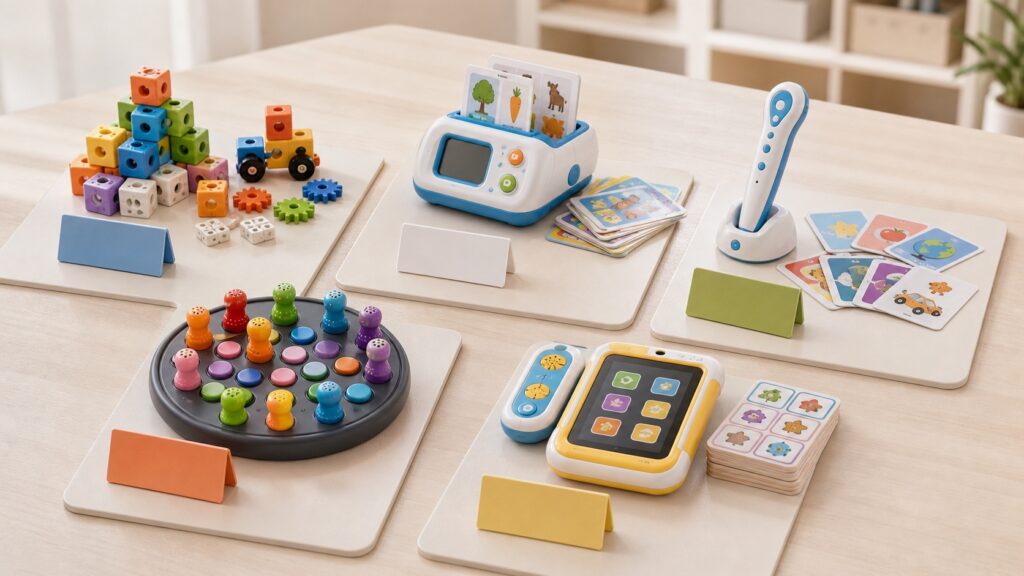
Product-line fit matters: buyers should confirm whether one supplier can support the product categories they plan to source or develop.
Before Requesting Prices: Prepare a Product Specification Sheet
A clear specification sheet helps suppliers quote the same project scope and reduces misunderstandings during sampling.
| Specification Item | What to Define |
|---|---|
| Product type | Card learning player, smart learning pen, STEM blocks, memory game, early-learning device, or mixed product line |
| Target age group | Age range required by your market, channel, or classroom use case |
| Learning goal | Language learning, logic training, memory practice, STEM assembly, circuit exploration, or mixed learning content |
| Interactive features | Sound, LED lights, scoring, quiz modes, point-and-learn interaction, AI play modes, or module combinations |
| Content and language | Audio scripts, card topics, printed learning materials, translation needs, and number of language versions |
| Electronics | Battery type, speaker, buttons, LED modules, PCBA requirements, charging method, and power-safety expectations |
| Customization | Logo, color, packaging, learning cards, audio content, firmware behavior, function modes, or tooling changes |
| Target channel | Retail, wholesale, distributor network, school procurement, classroom kit, or STEM course package |
| Testing and compliance | Destination market and required testing scope, such as EN71, ASTM, IEC 62115, 7P, HR4040, CE, or UKCA where applicable |
| Packaging and logistics | Retail box type, inner protection, barcode, warning labels, carton quantity, carton size, and gross/net weight |
Step 2: Evaluate the Supplier
Product-line fit is only the beginning. You also need to evaluate the supplier's operational reliability, communication quality, and willingness to support your project's specific requirements.
Supplier evaluation checklist:
- Manufacturing model: Is the supplier a factory (direct manufacturing) or a trading company reselling from third-party factories? Factory-direct partners can give buyers a shorter communication path for production schedules, QC feedback, and customization decisions, but buyers should still verify capacity, sample quality, and inspection workflow.
- OEM/ODM capability: Can they manufacture to your design (OEM), or co-develop products based on their existing platforms (ODM)? Both models have different lead-time and cost implications. Review the supplier's OEM/ODM educational toy customization process before your first call.
- Communication responsiveness: How quickly and clearly does the supplier respond to technical questions? A supplier that takes days to answer basic specification questions may indicate slower project coordination during sampling, customization, or mass production.
- Production capacity: Can they handle your order volume? Ask about monthly output, peak-season capacity, and how they manage concurrent orders from multiple buyers.
- Export experience: Does the supplier regularly export to your target market (EU, US, UK, Middle East, Southeast Asia, etc.)? Export-experienced factories are more likely to understand destination-market packaging and documentation requirements.
Evidence to Request Before Shortlisting a Supplier
Do not rely only on catalog pages or product photos. Ask the supplier to provide evidence that matches your project scope.
Useful evidence includes:
- Product videos showing real function, sound, light, card interaction, or assembly process.
- Existing sample availability and estimated timing for custom samples.
- Packaging examples, dielines, carton specifications, and labeling examples for similar products.
- Test reports or testing experience for similar electronic educational toys.
- QC workflow covering incoming materials, assembly, function testing, packaging checks, and pre-shipment inspection.
- A clear explanation of which customization items use existing tooling and which require new development.
Red flags include vague answers about testing, unclear MOQ by SKU, quotations without packaging or carton details, inability to explain firmware or audio customization, and claims that all products automatically meet every market requirement.
Step 3: Ask the Right Customization Questions
Interactive educational toys often require significant customization — especially around content, language, branding, and electronic features. Generic sourcing questions will get you generic answers. Specific questions save time.
Customization areas to cover:
| Customization Area | What to Ask |
|---|---|
| Language and audio | Can the factory produce audio content in your target language(s)? How many languages can a single device support? Who records the audio — in-house or subcontracted? |
| Content and curriculum | Can learning content be customized to match your local curriculum or brand's educational framework? |
| Branding and packaging | Can you apply your brand's logo, color scheme, and packaging design? Is there a minimum volume for custom packaging runs? |
| Electronic features | Can firmware be adjusted (e.g., adding quiz modes, adjusting difficulty levels, modifying light/sound behavior)? |
| Physical design | Can housing shapes, button layouts, or material finishes be modified from existing tooling, or does your design require new molds? |
| Card and print content | For card-based players and smart pens, can the factory print custom learning cards, books, or inserts? What print capabilities are available (offset, digital, laminated, coated)? |
If you're working with an ODM model, the supplier's existing product platform becomes your starting point. The goal is to understand which elements are easily customizable and which would require tooling investment or longer development timelines.
Choose the Right OEM or ODM Route
Many educational toy projects are not purely OEM or purely ODM. They often start from an existing product platform and add brand, language, content, packaging, or function changes.
| Route | Suitable For | Buyer Considerations |
|---|---|---|
| ODM from existing product platform | Faster product launch, private-label line expansion, distributor assortment building | Confirm which parts can be customized without new tooling, including logo, color, packaging, audio, cards, and language content |
| OEM based on buyer design | Unique product concept, exclusive structure, special function, or new learning system | Prepare drawings, function requirements, target cost, testing needs, tooling budget, and sample approval process |
| Hybrid ODM customization | Existing hardware with custom content, packaging, or learning kits | Clarify firmware limits, card-printing workflow, audio recording process, MOQ by customization type, and approval milestones |
Before choosing a route, ask the supplier which changes affect sample lead time, tooling cost, testing scope, and final MOQ.
If you are not sure which customization path fits your project, start with an existing product platform and list the changes you need: language, cards, packaging, logo, color, and function adjustments. This gives the supplier enough context to recommend whether ODM customization or a deeper OEM project is more practical.
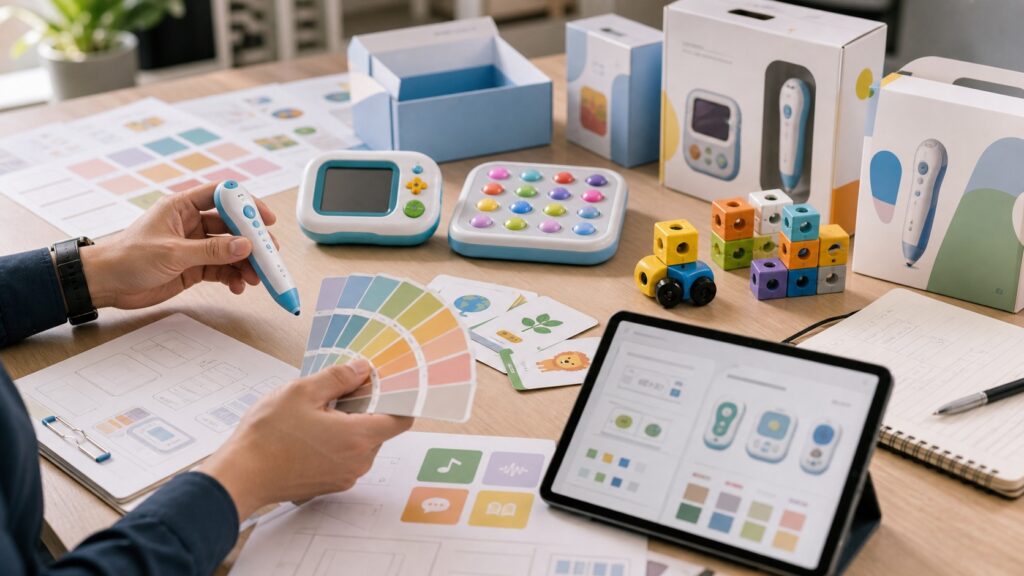
Customization decisions should be discussed early, especially language content, packaging, color, learning cards, function modules, and product-line positioning.
Step 4: Confirm Quality and Testing Support
For electronic educational toys, quality is not just about build — it's about electrical safety, material safety, and durability under repeated use by young children. Your target market's import requirements will dictate which standards and test reports you need.
Key points to verify:
- Testing capability: Can the supplier arrange or support testing according to your market's requirements? Relevant standards may include EN 71 (EU toy safety), ASTM F963 (US), IEC 62115 (electric toy safety), as well as substance-related requirements such as 7P phthalate testing and HR4040 flammability testing.
- Certifications and markings: Depending on your destination market, you may need CE marking (EU), UKCA marking (UK), or other market-specific documentation. Confirm whether the supplier has experience preparing products and documentation for these requirements.
- In-process quality control: Does the factory conduct in-line inspections, final random inspections, or both? Ask to see their QC workflow.
- Third-party inspection: Is the factory open to third-party inspection (e.g., SGS, Bureau Veritas, Intertek) at your request?
Products can be manufactured and tested according to project and market requirements, including EN71, ASTM, IEC 62115, 7P, HR4040, CE, and UKCA where applicable. Verify the specific test scope and applicable standards for each product and market on a per-project basis. Review the supplier's quality and testing support documentation as part of your evaluation.
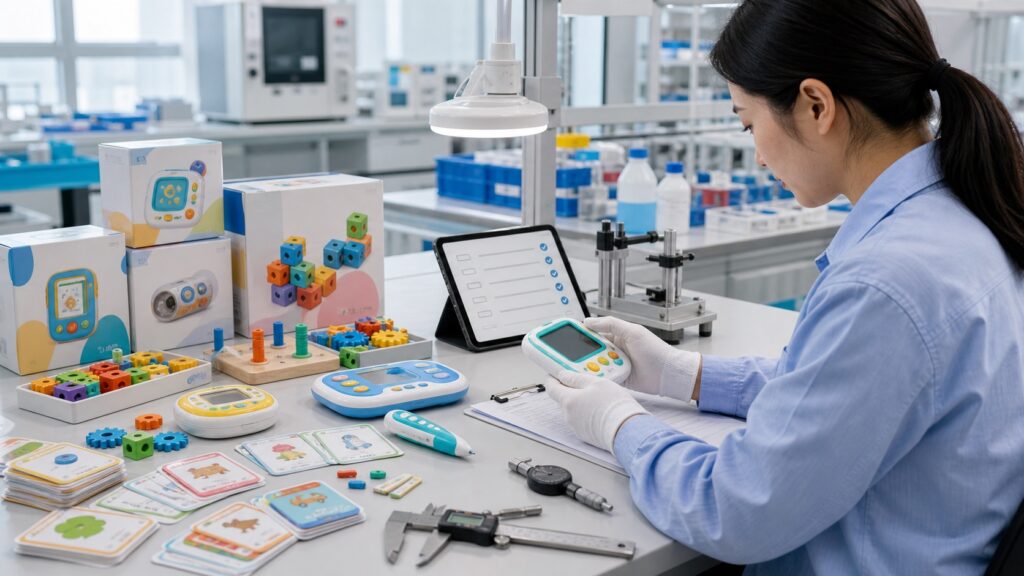
For electronic educational toys, quality review should cover materials, assembly, function checks, packaging, and market-specific testing support.
Step 5: Discuss Packaging Requirements Early
Packaging is frequently underestimated in B2B sourcing for educational toys. It affects landed cost, shelf presentation, retail compliance, and damage rates during shipping. Raise it early — not after samples are approved.
Packaging considerations:
- Retail-ready or bulk? Will the product ship in branded retail boxes (color box, window box, blister pack) or in bulk inner/outer cartons for your own repacking?
- Regulatory markings on packaging: Many markets require specific labeling on toy packaging — age warnings, choking hazard notices, importer details, CE/UKCA marks, battery information, and barcodes.
- Packaging materials: Are there sustainability requirements in your market (e.g., recyclable materials, reduced plastic)? Discuss material options and cost implications.
- Inner packaging and protection: For electronic toys, ask about foam inserts, blister trays, or compartmentalized boxes to prevent damage to screens, buttons, or small components during transit.
- Master carton specs: Confirm outer carton dimensions, units per carton, and gross/net weights for freight planning.
Step 6: Approach Samples and MOQs Practically
Samples and minimum order quantities are standard negotiation points, but approaching them practically avoids wasted time on both sides.
On samples:
- Request product samples early in the evaluation process. A physical sample tells you more about build quality, audio clarity, button feel, and material finish than any product sheet.
- Clarify whether the supplier offers existing-product samples (faster, lower cost) or custom samples (requires development time and may involve tooling fees).
- Free samples are usually limited. For serious B2B evaluation, budget for sample fees and courier costs, especially when customized audio, cards, packaging, or firmware adjustments are involved.
On MOQs:
- MOQs vary by product type, customization level, and order history. A standard product with existing tooling may have a lower MOQ than a fully customized OEM project requiring new molds or new content development.
- Ask the supplier to specify MOQs per SKU rather than accepting a blanket number. A smart learning pen with custom audio may have a different MOQ than a set of STEM logic blocks with standard packaging.
- For first orders, some suppliers may offer flexibility on MOQs to establish the relationship — ask directly rather than assuming.
Sample Approval Checklist
When samples arrive, evaluate them as a buyer, not only as an end user. For interactive educational toys, check:
- Function accuracy: quiz response, scoring, memory mode, point-and-learn interaction, or module assembly.
- Audio quality: volume, pronunciation, language accuracy, and sound clarity.
- Light and button feedback: LED visibility, button feel, response speed, and repeated-use stability.
- Printed content: card quality, color accuracy, lamination, coating, spelling, and curriculum fit.
- Child-friendly structure: edges, battery compartment, small parts, surface finish, and product weight.
- Packaging: box strength, inner protection, warning labels, barcode position, and retail shelf presentation.
- Documentation: user manual, age guidance, product specs, and any required market-specific labeling.
Use the approved sample as the reference for mass production and inspection.
Understand the Quote Beyond Unit Price
A low unit price is not useful unless the quotation covers the same product scope, packaging, customization, and testing requirements.
| Cost Driver | What to Clarify |
|---|---|
| Base product price | Existing product model, standard function, standard color, and included accessories |
| Custom content | Audio recording, translation, learning cards, printed books, cartridges, or curriculum artwork |
| Packaging | Color box, window box, blister tray, inner protection, carton specs, barcode, and warning labels |
| Tooling or mold cost | New housing, button layout, structural change, or exclusive product development |
| Firmware or function changes | Quiz modes, scoring rules, sound/light behavior, language switching, or difficulty levels |
| Testing and inspection | Market-specific test scope, third-party lab testing, pre-shipment inspection, or customer inspection |
| Logistics preparation | Carton dimensions, loading quantity, shipping marks, export documents, and Incoterms |
Ask suppliers to separate these items in the quotation so you can compare offers fairly.
Step 7: Prepare an Effective Sourcing Inquiry
The quality of your inquiry determines the quality of the supplier's response. Vague inquiries ("I'm interested in educational toys, please send catalog and price list") produce vague replies. A structured inquiry gets you specific, actionable information faster.
What to include in your inquiry:
- Your company profile — briefly state your business type (brand owner, importer, distributor, institution), your target market, and your approximate annual volume for this category.
- Product interest — specify which product types or categories you're interested in. Reference specific product lines if you've reviewed the supplier's range.
- Customization requirements — note any known customization needs: target languages, branding, content themes, packaging type, or electronic feature modifications.
- Target market and compliance — state your destination market and any known regulatory or testing requirements.
- Timeline — indicate your target delivery window or project stage (e.g., "evaluating suppliers for Q4 production" or "need samples within 3 weeks for internal review").
- Sample request — if you want samples, specify which products and whether you need standard or customized samples.
A well-prepared inquiry signals to the supplier that you are a serious buyer with a defined project — and it helps their sales and engineering teams prepare a relevant, detailed response.
If your sourcing brief already includes product type, target market, quantity, customization needs, testing requirements, packaging direction, and sample expectations, YSGO can review your project and recommend suitable interactive educational toy options.
Ready to start? Send your sourcing brief to YSGO with the details above.
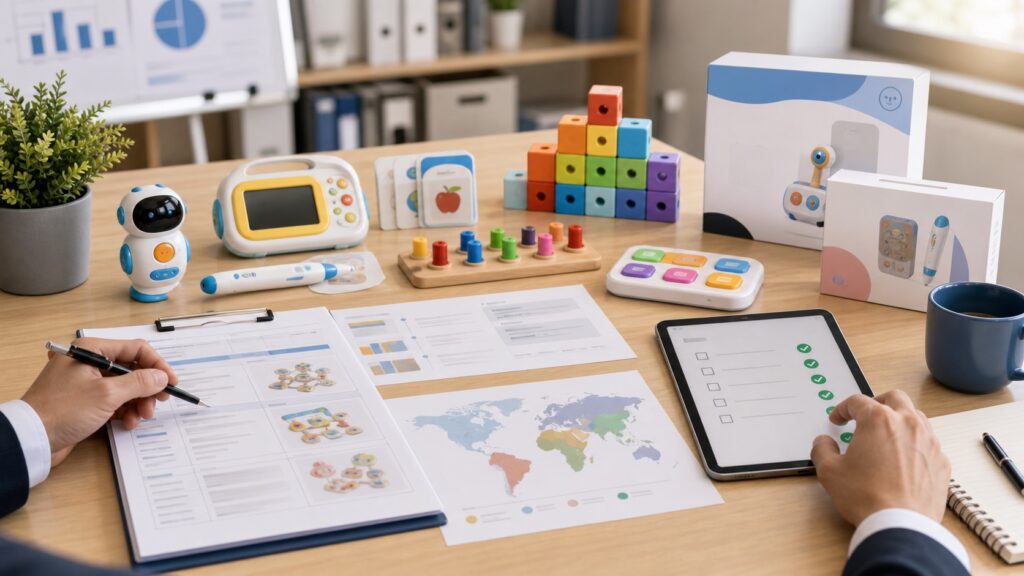
A clear inquiry package helps suppliers respond with more relevant product recommendations, sample options, customization paths, and quotation details.
Frequently Asked Questions
What types of interactive educational toys can be sourced from China?
China-based manufacturers produce a wide range of interactive educational toys, including card-based electronic learning players, smart learning pens with point-and-learn and multi-language capabilities, STEM logic and building block sets, electronic memory and strategy game boards, and early learning tablets and phone-shaped devices. Many factories offer both existing product platforms and custom development options across these categories.
What is the difference between OEM and ODM when sourcing educational toys?
In OEM (Original Equipment Manufacturing), the buyer provides the product design and specifications, and the factory manufactures to that design. In ODM (Original Design Manufacturing), the factory offers existing product platforms that the buyer can customize with their own branding, content, language, and packaging. ODM often reduces development time and upfront tooling cost when the existing product platform already fits the buyer's market and customization scope, while OEM allows more design control but requires more investment in development.
How do I verify that an educational toy manufacturer can meet my market's safety requirements?
Ask the supplier which safety and compliance standards they have experience supporting — for example, EN 71, ASTM F963, IEC 62115, or CE and UKCA marking requirements. Request copies of relevant test reports for similar products. Confirm whether the factory supports third-party inspection and whether they can arrange testing through accredited laboratories. Always verify the specific test scope required for your product type and destination market, as requirements vary.
Should I visit the factory before placing an order?
A factory visit is valuable but not always necessary for the first order, especially if the supplier can provide product samples, factory audit reports, and references. If a visit is not practical, request a virtual factory tour, ask for photos or video of the production line, and consider engaging a third-party inspection service for pre-shipment checks. For larger or ongoing partnerships, an in-person visit is recommended.
How should I handle language and content customization for different markets?
Discuss language and content requirements early in the project. Key questions include how many languages a single device can support, whether the factory records audio in-house or subcontracts it, and whether learning content can be adapted to match your local curriculum or educational framework. For card-based and pen-based products, clarify printing capabilities for custom learning cards and books in your target language(s). An experienced supplier should be able to explain its workflow for audio production, content approval, printing, sample confirmation, and mass production.
What should I prepare before asking for a quotation?
Prepare your target product type, buyer channel, destination market, estimated order quantity, required customization, language needs, packaging type, sample expectations, and any known testing or compliance requirements. If you are sourcing smart learning toys or card-based educational toys, also prepare content requirements such as audio language, card topics, quiz structure, and curriculum direction.
How can I compare interactive educational toy suppliers beyond price?
Compare suppliers using the same specification sheet. Check whether each quotation includes the same product functions, accessories, packaging, carton details, customization scope, testing requirements, sample cost, and inspection support. For electronic educational toys, a cheaper quote may exclude important items such as custom audio, printed learning cards, firmware adjustment, retail packaging, or third-party testing.
Can interactive educational toys be customized for private label brands?
Yes, many interactive educational toys can be customized for private-label projects, depending on the product platform and order quantity. Common customization options include logo, color, packaging, language audio, learning cards, printed content, function modes, and product kits. For structural changes, firmware changes, or new molds, buyers should confirm development cost, sample timing, testing scope, and MOQ before approving the project.
What documents should I request before shipment?
Before shipment, ask for the approved sample reference, proforma invoice, packing list, carton marks, product and packaging photos, relevant test reports or testing plan, and inspection report if inspection is arranged. The exact document set depends on the destination market, buyer compliance process, product type, and agreed Incoterms.
Which interactive educational toy product lines are suitable for schools or STEM education programs?
Schools, kindergartens, and STEM education programs usually need products with clear learning goals, repeated-use durability, and easy activity organization. STEM Logic Thinking Training Blocks are suitable for hands-on STEM assembly and logic training. Y-Challenge Chess & Memory Games support concentration, memory, and reaction activities. Y-Pen Smart Learning Pens and Y-Card Learning Players can support language, quiz, and card-based learning when the content matches the teaching scenario.
Start Your Sourcing Project
If you're evaluating interactive educational toys manufacturers for your next product line or institutional order, use this checklist to structure your supplier conversations.
YSGO is a China-based factory-direct partner for interactive educational toys, offering OEM/ODM customization, quality and testing support, and production across STEM blocks, smart learning pens, card-based players, electronic memory games, and early learning devices.